The jewelry industry is currently witnessing its most significant shift in a century. At Wilton Jewelers, the question on every engagement ring buyer’s lips is no longer just about clarity or cut, but about origin: lab grown vs natural diamonds. For decades, a diamond was defined by its journey from deep within the earth’s mantle. Today, technology has allowed us to replicate those exact volcanic conditions in a laboratory.
As a consultant who has seen the transition from traditional mining to high-tech carbon vapor deposition, I, Jack Reacher, understand the confusion. Is a lab-grown diamond “real”? Is a natural diamond still a good investment? In this 1500-word masterclass, we will strip away the marketing jargon and give you the cold, hard facts about both, ensuring your choice at Wilton Jewelers is one you won’t regret in twenty years.
The Science: Are They Chemically Identical?
Let’s settle the most important point first: Lab-grown diamonds are real diamonds. They are not “fakes,” they are not cubic zirconia, and they are not moissanite.
In the debate of lab grown vs natural diamonds, both stones share the exact same chemical, physical, and optical properties. They both consist of pure carbon arranged in a cubic crystal structure. Even the most experienced gemologists at Wilton Jewelers cannot tell the difference with the naked eye or a traditional jeweler’s loupe. It requires specialized, high-cost machinery to detect the growth patterns that distinguish a lab-created stone from one mined from the earth.
How They Are Made: Earth vs. Lab
- Natural Diamonds: Formed 1 to 3 billion years ago, approximately 100 miles below the earth’s surface under immense heat and pressure. They are brought to the surface by volcanic eruptions called kimberlite pipes.
- Lab Grown Diamonds: Created using two primary methods—HPHT (High Pressure High Temperature) or CVD (Chemical Vapor Deposition). These processes take weeks rather than eons, but the result is a diamond crystal identical to the ones found in mines.
Comparison Table: At a Glance
For our international clients at Wilton Jewelers, here is the breakdown of the lab grown vs natural diamonds comparison:
| Feature | Natural Diamond | Lab-Grown Diamond |
| Composition | Pure Carbon | Pure Carbon |
| Brilliance/Sparkle | 100% Identical | 100% Identical |
| Durability (Mohs) | 10 | 10 |
| Resale Value | 50% – 70% of Market | Low to Minimal |
| Price Point | Premium | 70% – 90% Less Expensive |
| Eco-Impact | High (Mining) | Low to Moderate (Energy Use) |
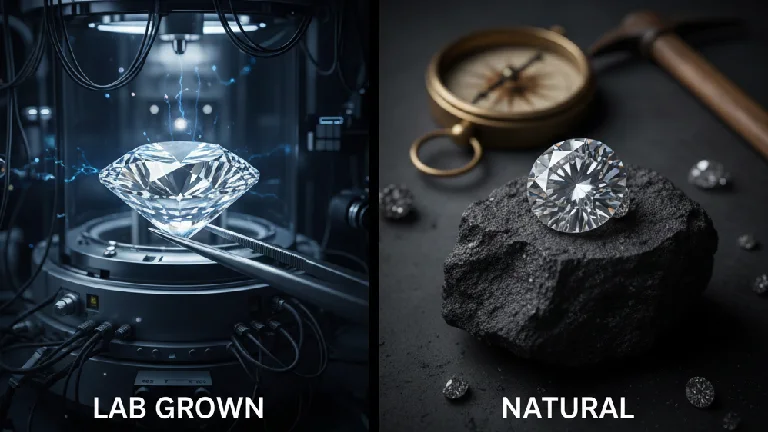
[Image showing a high-tech diamond growth chamber vs. a traditional open-pit diamond mine]
1. The Price Factor: Getting More Carats for Your Dollar
The most compelling reason people choose lab grown vs natural diamonds is the cost. Because the supply chain for lab diamonds is much shorter and more predictable, they are significantly cheaper.
At Wilton Jewelers, we find that a client with a $5,000 budget can typically afford a 1-carat natural diamond of good quality. However, that same $5,000 could buy a 3-carat lab-grown diamond of exceptional quality. For the modern couple looking to make a massive visual impact on a budget, lab-grown stones are the clear winner.
2. Investment and Resale Value: The Hard Truth
As an investment specialist, I must be honest with you. While lab-grown diamonds are “real,” they do not hold their value like natural diamonds do. Natural diamonds are finite resources; there is only a limited amount of them in the earth. This scarcity drives long-term value.
In the lab grown vs natural diamonds debate, lab stones are considered “technology products.” Much like a high-end smartphone, the price of lab diamonds has been dropping as technology improves. If you plan to sell your ring in 10 years, a natural diamond will retain a significant portion of its value. A lab diamond likely will not. At Wilton Jewelers, we advise that you buy a lab diamond for its beauty, but buy a natural diamond for its legacy.
3. The Ethics of “Eco-Friendly” Diamonds
Many of our UK and Australian clients prioritize sustainability. Lab-grown diamonds are often marketed as the “ethical” choice because they do not involve mining. However, it is important to remember that labs require a massive amount of electricity to simulate the earth’s heat.
At Wilton Jewelers, we ensure all our natural diamonds are sourced via the Kimberley Process, which prevents “conflict diamonds” from entering the market. Whether you choose lab grown vs natural diamonds, we guarantee an ethical path from the source to your finger.
Clarity and Grading: The Universal Standard
Regardless of origin, both stones are graded on the same scale of the 4Cs (Cut, Color, Clarity, and Carat).
Because lab diamonds are grown in controlled environments, it is much easier to find “Flawless” or “VVS” stones at a lower price point. When you are looking for that perfect sparkle at Wilton Jewelers, a lab diamond often allows you to “spec up” in clarity without the natural diamond price tag.
Gold Purity Pairing: 14k vs 18k
When mounting your stone, the choice of metal remains vital. A 2-carat lab diamond is just as heavy as a 2-carat natural diamond.
- 14k Gold: Recommended by Wilton Jewelers for its strength, especially for larger lab-grown stones that need secure prongs.
- 18k Gold:Recommended for those wanting the highest prestige to match their natural diamond investment.
International Sizing and Logistics
A common concern for our international buyers is whether a lab-grown ring can be resized. The answer is yes! Since the metal is exactly the same (14k or 18k gold), any local jeweler can resize a lab-grown ring just as easily as a natural one.
| US/Canada Size | UK/Australia Size | Inside Diameter (mm) |
| 6 | L 1/2 | 16.5 mm |
| 7 | N 1/2 | 17.3 mm |
External Authority: Validating the Science
If you are still skeptical, I encourage you to read the 2018 ruling by the Federal Trade Commission (FTC). They officially removed the word “natural” from the definition of a diamond, confirming that lab-grown stones are chemically the same as mined ones. This was a landmark moment in the lab grown vs natural diamonds history.
Jack Reacher’s Professional Recommendation
- Choose a Natural Diamond if: You value tradition, rarity, and want an heirloom that will retain financial value for the next generation.
- Choose a Lab-Grown Diamond if: You want the biggest, sparkliest stone possible for your budget and you aren’t concerned with future resale value.
At Wilton Jewelers, we believe the “right” diamond is the one that makes you smile when you look at your hand. There is no wrong choice, only a different set of priorities.