In the world of high-end horology, terminology can often feel like a secret language designed to intimidate the uninitiated. At Wilton Jewelers, one of the most persistent questions I receive from new collectors is: “Jack, should I buy an automatic watch or a self-winding watch?” The answer usually surprises them. In the industry, the debate of automatic vs self-winding watches is actually a discussion about two names for the exact same technology.
I am Jack Reacher, and I have spent my career inside the workshops of Geneva and the retail floors of London. Today, I am going to demystify these terms once and for all. In this 1500-word masterclass, we will explore why these terms are used interchangeably, how the technology revolutionized the way we wear time, and why this specific type of movement is the “gold standard” for luxury investments at Wilton Jewelers.
The Great Reveal: One Movement, Two Names
To put it simply: An automatic watch IS a self-winding watch. In the early days of watchmaking, every timepiece was “manual,” meaning you had to turn a small knob (the crown) every single day to tighten a spring inside. When engineers finally figured out how to make a watch tighten its own spring using the kinetic energy of the wearer’s arm, they called it a “self-winding” mechanism. Over time, the marketing world adopted the term “automatic” because it sounded more modern and effortless.
Whether you are browsing the collection at Wilton Jewelers or reading a technical manual from Rolex, remember that both terms refer to a mechanical watch that powers itself through your daily movement.
The Magic of the Rotor: How It Actually Works
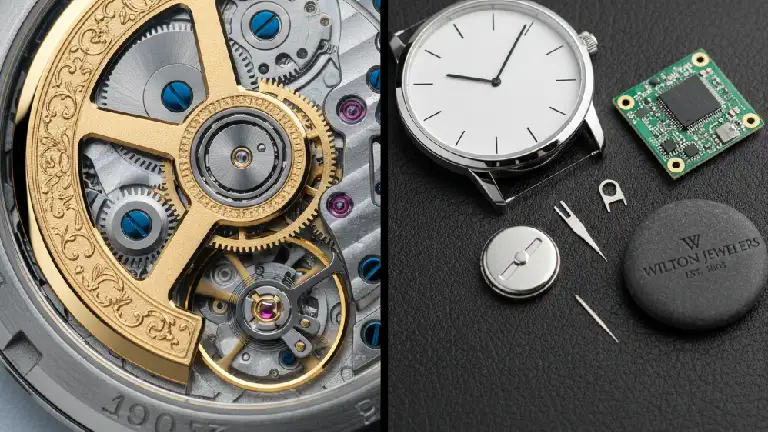
The heart of the automatic vs self-winding watches technology is a component called the Rotor. If you look through the clear “exhibition” case back of a luxury watch, you will see a semi-circular piece of metal, usually made of a heavy material like tungsten or even 22k gold.
As you move your wrist to check your phone, grab a coffee, or walk down the street, gravity causes this rotor to pivot. This spinning motion is transferred through a series of reducing gears to the mainspring.
- The Result: The watch is “automatically” winding itself while you go about your day.
- The Convenience: As long as you wear the watch for 8 to 10 hours a day, it will never stop ticking.
Comparing the Three Main Movements
For our global clients at Wilton Jewelers, it is helpful to see where the automatic/self-winding movement fits in the broader landscape of horology:
| Movement Type | Power Source | User Interaction | Accuracy |
| Manual Wind | Mainspring | Must turn crown daily | High |
| Automatic (Self-Winding) | Mainspring + Rotor | Powered by wrist motion | High |
| Quartz | Battery | None (until battery dies) |
1. The Pros: Why Automatic is the Collector’s Choice
At Wilton Jewelers, 90% of our high-end sales are automatic movements. Here is why:
- Convenience: You never have to worry about the watch stopping as long as it’s on your wrist.
- Longevity: Unlike quartz watches with electronic circuits that can fry, a self-winding mechanical watch can be repaired and serviced for a century.
- The “Sweep”: Because it is mechanical, the second hand moves in a smooth, elegant sweep rather than the staccato “tick-tick” of a battery-powered watch.
2. The Cons: What to Watch Out For
While we love them, automatic vs self-winding watches do have specific needs:
- Thickness: Because of the added rotor, these watches are often slightly thicker than manual or quartz watches.
- Power Reserves: If you take the watch off for a weekend, it will eventually run out of “juice” (usually after 40 to 70 hours). This is why many Wilton Jewelers clients use a “Watch Winder”—a box that rotates the watch at night to keep it wound.
Investment Value: Holding Your Wealth on Your Wrist
From a financial perspective, a self-winding watch is a “hard asset.” Much like the 14k gold we discuss in our jewelry guides, a mechanical movement has intrinsic value.
When you pair a high-grade automatic movement with an 18k gold casing, you are creating an heirloom. At Wilton Jewelers, we have seen the resale value of automatic Swiss watches increase by 20% to 50% over a five-year period for certain brands, whereas quartz models rarely hold their retail price.
Maintenance: The “Oil and Filter” Change
A self-winding watch is like a high-performance Italian sports car. It has hundreds of moving parts and microscopic oils that keep them running smoothly. I, Jack Reacher, recommend a professional service at Wilton Jewelers every 5 to 7 years.
During this service, we:
- Completely disassemble the movement.
- Clean every gear in an ultrasonic bath.
- Apply four different types of specialized synthetic oils.
- Recalibrate the timing to ensure it meets the “Chronometer” standard.
International Sizing and Comfort
Because automatic watches have more “heft,” the fit is vital. A watch that slides too much on the wrist won’t wind efficiently because the rotor won’t get the sharp movements it needs.
| US/Canada Size | UK/Australia Size | Wrist Circumference (inches) |
| Small | L to N | 6.0″ – 6.5″ |
| Medium | O to Q | 7.0″ – 7.5″ |
| Large | R to T | 8.0″+ |
External Authority: The Pursuit of Precision
For those who want to see the official testing standards for these movements, the FHH (Fondation de la Haute Horlogerie) is the ultimate resource. They define the “High Horology” standards that we uphold at Wilton Jewelers.
Jack Reacher’s Final Recommendation
In the debate of automatic vs self-winding watches, remember that the name doesn’t matter—the quality of the movement does.
- If you are a daily wearer: Go for a self-winding (automatic) model. The convenience is unbeatable.
- If you are a purist: You might prefer a manual wind for its thinner profile and the “ritual” of winding.
At Wilton Jewelers, we believe the heartbeat of a self-winding watch is a testament to human ingenuity. It is a piece of art that only lives as long as you move.
About the Author: Jack Reacher
Jack Reacher is a senior horological consultant for Wilton Jewelers. With over 15 years of experience specializing in Swiss automatic movements and vintage timepiece restoration, Jack is a recognized voice in the global watch community. He has consulted for major auction houses in London and New York and is passionate about preserving the art of mechanical timekeeping for future generations.