Introduction: The Heartbeat of Horology
In the grand theater of luxury timepieces, the debate of mechanical vs quartz watches is far more than a technical comparison; it is a clash of philosophies. One represents the triumph of centuries-old human engineering—gears, springs, and gravity—while the other represents the pinnacle of modern electronic precision. At Wilton Jewelers, we believe that a watch is the only piece of jewelry that truly has a “heartbeat.” Whether you are a seasoned collector in London or a first-time buyer in New York, understanding what happens behind the dial is crucial. I am Jack Reacher, and in this 1500-word guide, we will dissect these movements to see which one deserves the investment of your hard-earned capital.
The Mechanical Marvel: A Legacy in Motion
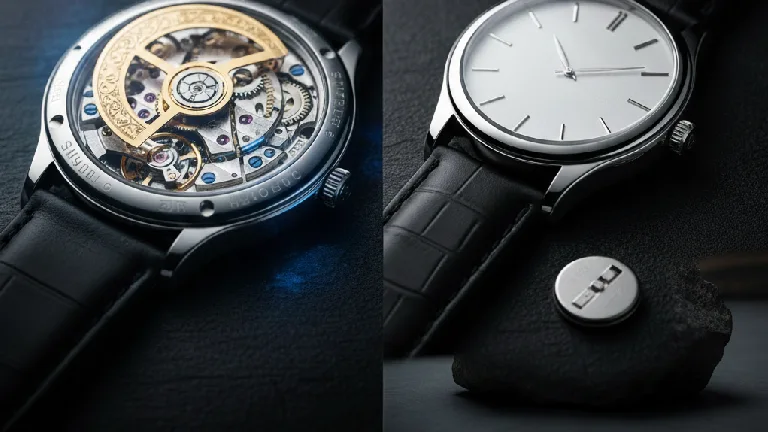
To understand the allure of a mechanical watch, one must appreciate the absence of a battery. These watches are powered by a mainspring, which stores energy and releases it through a complex series of gears and an escapement.
- Manual Movements: Require the wearer to turn the crown regularly to tension the spring.
- Automatic Movements: Utilize a weighted rotor that spins with the natural motion of your wrist, winding the watch automatically.
When discussing mechanical vs quartz watches, the defining visual characteristic is the “sweep.” A mechanical second hand glides smoothly across the dial—a micro-ballet of engineering that signifies luxury. At Wilton Jewelers, we find that our most passionate clients are drawn to the “soul” of these machines.
The Quartz Revolution: Precision and Utility
Introduced in the late 1960s, quartz technology nearly decimated the traditional Swiss watch industry. A quartz watch uses a tiny battery to send an electric current through a small quartz crystal. This crystal vibrates at an incredibly high and stable frequency (32,768 times per second). This vibration is then converted into a steady one-second pulse.
In any objective test of mechanical vs quartz watches regarding accuracy, quartz is the undisputed champion. A basic quartz watch might lose 15 seconds a month, whereas even a COSC-certified mechanical chronometer might lose 2 to 4 seconds a day. For the pragmatic professional who values punctuality above all else, quartz is the logical choice.
Step 1: The Movement Comparison Reference
To help our global clientele at Wilton Jewelers make an informed decision, I have developed this comparative framework:
| Feature | Mechanical Watch | Quartz Watch |
| Power Source | Kinetic/Mainspring | Battery |
| Second Hand Motion | Smooth Sweep | Stepping “Tick” |
| Accuracy | +/- 5 Seconds per Day | +/- 15 Seconds per Month |
| Craftsmanship | Hand-Assembled / High Art | Mass-Produced / Industrial |
| Long-term Value | High Appreciation Potential | Functional Value Only |
| Service Interval | 5-10 Years (Overhaul) | 2-3 Years (Battery Change) |
The Investment Perspective: Why Heritage Matters
If you are looking at your timepiece as a financial asset, the mechanical vs quartz watches debate ends quite quickly. Mechanical watches, particularly those from heritage “Maisons” like Patek Philippe, Vacheron Constantin, and Rolex, are treated as “portable wealth.”
Because a mechanical watch can be repaired indefinitely—every gear can be remade by a master watchmaker—it has a lifespan that spans centuries. In contrast, once a quartz circuit board is discontinued by a manufacturer, the watch may become unrepairable in 30 years. At Wilton Jewelers, we advise our investors to view mechanical pieces as heirlooms and quartz pieces as high-performance tools.
The Durability Factor: Casing and Environment
Durability in horology is a twofold concept. Quartz watches are technically more “durable” regarding shocks; if you drop a quartz watch, the crystal and battery are likely to survive. A mechanical watch contains hundreds of microscopic parts that can be knocked out of alignment by a heavy impact.
However, the “casing” purity remains a constant. Whether you choose a mechanical or quartz piece, the gold content of the case is a major value driver.
| Gold Purity | Ideal Use in Horology | Resale Factor |
| 18k (750) | High Luxury / Dress Watches | Excellent |
| 14k (585) | Vintage / Mid-Tier Luxury | High |
| Steel (904L) | Sports Watches / Daily Wear | Exceptional (Rolex Standard) |
The Aesthetics of Jewelry and Watch Pairing
A watch never exists in isolation; it must harmonize with your jewelry. At Wilton Jewelers, we often assist clients in matching their watch to their wedding bands. A mechanical watch has a certain “heft” or weight that complements 14k or 18k gold jewelry.
When a watch is fitted to your wrist, the metal links must be adjusted with the same precision as a ring sizing. A mechanical watch, with its complex weight, requires a perfectly balanced fit to ensure the automatic rotor functions at peak efficiency.
Servicing: The Cost of Ownership
One must be prepared for the maintenance of a mechanical masterpiece. A service at Wilton Jewelers involves a complete teardown of the movement, ultrasonic cleaning of every gear, and precise lubrication. It is a labor-intensive process that justifies the watch’s longevity.
A quartz watch requires a simple battery change every few years. While cheaper in the short term, the lack of “horological depth” means it will never command the same respect in the auction houses of Geneva or New York.
External Authority: The Standard of Excellence
To verify the claims of any luxury watch, I always recommend my clients look for the COSC Certification. The Contrôle Officiel Suisse des Chronomètres is the independent body that tests Swiss movements for extreme accuracy. A watch that carries this certification has surpassed the standard “mechanical vs quartz” limitations.
Jack Reacher’s Final Verdict
- The Case for Quartz: If you want a slim, reliable, and maintenance-free watch that you can pick up and wear at any moment without resetting the time, quartz is your winner.
- The Case for Mechanical: If you want to own a piece of history, a machine that breathes with your movement, and an asset that your grandchildren will one day wear, the mechanical watch is the only choice.
At Wilton Jewelers, we stock both, but we sell a “story” with every mechanical piece.