A diamond’s greatest asset is its ability to manipulate light. However, the very chemistry that makes a diamond a “girl’s best friend” also makes it a magnet for oils. At Wilton Jewelers, we often see magnificent stones that have lost their “fire” simply because of a buildup of daily grime. Whether it is an engagement ring, a pair of studs, or a pendant, knowing how to clean diamonds is an essential skill for any owner. In this 1500-word masterclass, I, Jack Reacher, will take you through the professional-grade methods used by jewelers in London and New York, adapted for your kitchen counter.
Why Diamonds Attract Dirt: The Lipophilic Nature
Diamonds are lipophilic, meaning they have a natural affinity for grease and oils. When you apply hand lotion, hairspray, or even when you touch the stone with your fingers, you leave behind a microscopic layer of oil. Over time, these layers stack up, creating a cloudy film. This film prevents light from entering the stone and reflecting off the internal facets. At Wilton Jewelers, we emphasize that a “dirty” diamond isn’t just an aesthetic issue; it hides the stone’s true quality and value.
The Common Household Dicks to Avoid
Before we master how to clean diamonds, we must address the dangerous “hacks” found on the internet.
- Toothpaste: Many believe toothpaste is a safe abrasive. It is not. It can scratch the gold or platinum setting and leave a residue that is harder to remove than the original oil.
- Bleach and Chlorine: These are the enemies of precious metal alloys. They can cause stress corrosion, making your 14k gold setting brittle and prone to snapping.
- Boiling Water: While heat helps break down grease, extreme temperature changes (thermal shock) can cause some diamonds with internal inclusions to fracture.
Step 1: The Ultimate 10-Step Home Cleaning Process
This is the official Wilton Jewelers protocol for maintaining a world-class sparkle:
- Preparation: Check your setting. Ensure no stones are loose before you begin.
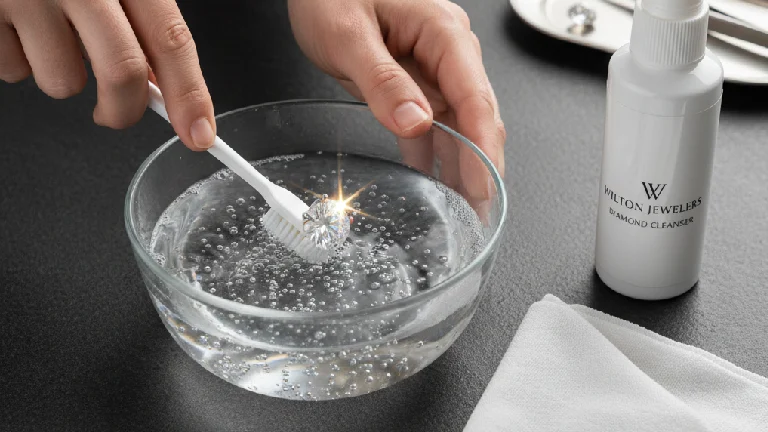
- The Solution: Mix warm water with a few drops of mild, sodium-lauryl-sulfate-free dish soap.
- The Soak: Place your jewelry in the bowl. Let it sit for 30 to 40 minutes.
- The Brushing: Use a brand-new, extra-soft toothbrush.
- The Technique: Brush the “pavilion” (the bottom) of the diamond. This is where most dirt accumulates.
- The Under-Gallery: Clean the small gaps in the metal setting.
- The Rinse: Rinse under a stream of warm water. Warning: Ensure the sink drain is closed or covered with a strainer.
- The Inspection: Look at the stone under a bright light to check for remaining spots.
- The Final Rinse: Use distilled water if you live in a “hard water” area to avoid mineral spots.
- The Dry: Use a lint-free microfiber cloth or a hairdryer on a “cool” setting.
Understanding Diamond Clarity and the Cleaning Process
When you learn how to clean diamonds, you start to notice the internal characteristics of your stone. This is the best time to understand the GIA clarity scale.
- FL/IF (Flawless): Will look like a pool of pure water when clean.
- VVS/VS: May show tiny “pinpoints” under a loupe.
- SI/I: Cleaning may reveal “feathers” or “clouds” that were hidden by surface grease.
At Wilton Jewelers, we believe that a clean stone is the only way to truly appreciate the clarity you paid for.
Special Considerations for Different Metal Types
The metal holding your diamond dictates how aggressive you can be:
- 14k Yellow Gold: Highly resilient; the standard soap method is perfect.
- Platinum: While chemically resistant, it is prone to “patina.” Cleaning the diamond won’t remove scratches from the metal; that requires a professional polish.
- White Gold: Be cautious. White gold is plated with Rhodium. Over-scrubbing with a stiff brush can wear down this plating, revealing a yellowish tint underneath.
Purity and Hallmark Awareness
While cleaning, always verify your hallmarks to ensure you are treating the metal correctly.
| Karat | Gold Content | Hallmark | Care Level |
| 18k | 75% | 750 | High (Soft Metal) |
| 14k | 58.3% | 585 | Moderate |
| 10k | 41.7% | 417 | Low (Very Durable) |
Professional Tools for Home Use
If you want to move beyond the toothbrush, Wilton Jewelers suggests:
- Jewelry Polishing Cloths: Infused with specialized cleaners for the metal.
- On-the-go Cleaning Pens: Great for a quick touch-up between professional cleanings.
- Ionic Cleaners: Safer than ultrasonic cleaners for most daily-wear jewelry.
When to See a Professional at Wilton Jewelers
Knowing how to clean diamonds at home is great for weekly maintenance, but it does not replace a professional jeweler. You should visit us if:
- The diamond “jiggles” in the setting.
- The prongs catch on your clothing (this means they are lifted).
- There is a “cloudiness” inside the stone that soap cannot reach.
International Sizing and Maintenance
A clean ring often feels looser on the finger. Use this chart to ensure your ring still fits perfectly after its bath:
| US Size | UK/AU Size | Inside Diameter |
| 5 | J 1/2 | 15.7 mm |
| 7 | N 1/2 | 17.3 mm |
| 9 | R 1/2 | 19.0 mm |
External Authority: Validating Your Care Routine
For a deeper dive into the chemical composition of diamonds and why they require specific care, the Gemological Institute of America (GIA) offers extensive resources. Their research into gemstone longevity is the backbone of the advice we give at Wilton Jewelers.
Conclusion: A Commitment to Brilliance
In conclusion, how to clean diamonds is about more than just sparkle—it’s about preservation. By following this 1500-word guide, you are ensuring that your investment remains as vibrant as your memories. Treat your jewelry with the respect it deserves, and it will shine for generations.