
Diamonds are among the most captivating natural treasures, admired worldwide for their beauty and rarity. But have you ever wondered how are diamonds made? The journey from carbon deep within the Earth to the sparkling gemstones we cherish is both complex and fascinating. Understanding this process not only reveals the wonder of nature but also highlights the science behind one of the world’s most valued minerals.
In this article, we will explore the formation of diamonds, the conditions required, the methods of extraction, and the transformation from rough stones to polished gems. By the end, you’ll have a complete understanding of how diamonds are made, offering insight into their value, rarity, and allure.
What Is a Diamond?
A diamond is a crystalline form of carbon, formed under extreme pressure and temperature conditions. Despite being chemically simple, carbon atoms in diamonds arrange themselves in a tightly bonded crystal structure, which gives diamonds their hardness, brilliance, and durability. The unique formation process is what sets diamonds apart from other gemstones and minerals.
The Geological Formation of Diamonds
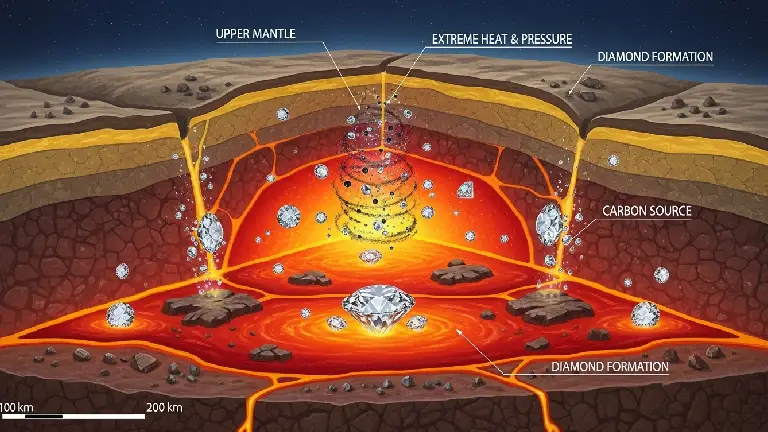
Understanding how diamonds are made begins with geology. Diamonds originate deep in the Earth’s mantle, roughly 90 to 150 kilometers below the surface. Here, carbon-rich materials experience pressures exceeding 725,000 pounds per square inch and temperatures above 1,000 degrees Celsius.
The Carbon Source
The primary ingredient for diamonds is carbon. This carbon may come from ancient carbon deposits in the Earth’s mantle or from subducted oceanic plates rich in organic carbon. Over millions of years, this carbon slowly transforms under extreme conditions, forming diamond crystals.
High Pressure and High Temperature (HPHT) Conditions
The intense pressure and heat in the Earth’s mantle are essential for diamond formation. These conditions force carbon atoms into a rigid lattice structure, creating diamonds. Without these extreme HPHT conditions, carbon would remain graphite or other less dense forms.
How Are Diamonds Made Over Time
Diamonds are not instantaneous creations; they require millions to billions of years to form. The slow growth allows crystals to develop into the distinct shapes known for their clarity and strength.
Crystallization Process
The carbon atoms bond in a tetrahedral lattice pattern, creating a structure that is exceptionally strong. This lattice is the reason diamonds are the hardest known natural material. Over millions of years, these crystals grow larger, and some reach significant sizes suitable for gemstone use.
Transport to the Surface: Volcanic Eruptions
Once diamonds form, they remain deep underground until geological events bring them closer to the surface. Volcanic eruptions play a crucial role, as magma pushes diamonds upward through kimberlite and lamproite pipes. These vertical conduits act like natural elevators, transporting diamonds from the mantle to the crust.
Mining Diamonds
After reaching the Earth’s crust, diamonds can be mined either through open-pit mining, underground mining, or alluvial mining.
-
Open-pit mining: Suitable for shallow deposits, this method removes large quantities of earth to access diamonds.
-
Underground mining: Targets deeper deposits, often more labor-intensive and costly.
-
Alluvial mining: Collects diamonds from riverbeds and coastal areas, where they have been naturally transported.
Industrial vs. Gem-Quality Diamonds
Not all diamonds are suitable for jewelry. Rough diamonds are graded based on size, clarity, color, and shape. Industrial diamonds are used for cutting, grinding, and drilling due to their hardness, while gem-quality diamonds undergo a careful polishing process to enhance their brilliance.
The Art of Polishing Diamonds
Once mined, diamonds are cut and polished to reveal their full beauty. Expert cutters study the crystal structure to determine the best angles, maximizing light reflection. This transformation from rough stone to sparkling gemstone is the final step in understanding how diamonds are made into the treasures we admire.
Comparison Chart: Natural vs. Synthetic Diamonds
| Feature | Natural Diamonds | Synthetic Diamonds |
|---|---|---|
| Formation Time | Millions to billions of years | Weeks to months |
| Origin | Earth’s mantle | Laboratory-controlled environment |
| Carbon Source | Organic carbon | Pure carbon compounds |
| Price | High due to rarity | Lower cost |
| Uses | Jewelry & industrial | Jewelry & industrial |
This chart shows the differences between naturally occurring diamonds and those created synthetically in labs. Both are chemically identical, but the origin and formation process are vastly different.
Environmental Impact of Diamond Mining
While diamonds are beautiful, mining them impacts the environment. Open-pit mining can cause deforestation and habitat loss, while underground mining may disturb ecosystems. Sustainable mining practices and lab-grown diamonds offer alternatives to reduce environmental footprints.
How Are Diamonds Made in Laboratories?
Lab-grown diamonds replicate natural HPHT or chemical vapor deposition (CVD) conditions to create crystals. This allows for ethical and environmentally friendly production of gem-quality diamonds. While synthetic, these diamonds are virtually identical to natural ones in chemical composition and brilliance.
Cultural Significance of Diamonds
Diamonds symbolize love, wealth, and status in cultures worldwide. Their rarity, combined with their mesmerizing sparkle, makes them a popular choice for engagement rings, heirlooms, and luxury items. Knowing how diamonds are made adds depth to their cultural and emotional significance.
FAQs
1. How long does it take for diamonds to form naturally?
Natural diamonds take millions to billions of years to form under extreme heat and pressure deep within the Earth.
2. Are synthetic diamonds real diamonds?
Yes, synthetic diamonds are chemically identical to natural diamonds but are created in controlled lab environments.
3. Can diamonds form anywhere on Earth?
No, diamonds form only under very specific conditions found in the Earth’s mantle, then transported to the surface through volcanic pipes.
4. What determines the quality of a diamond?
Quality is assessed by the 4 Cs: cut, clarity, color, and carat weight, which influence brilliance and value.
5. Do all diamonds come from Africa?
While Africa is a major source, diamonds are also mined in Russia, Canada, Australia, and other regions with suitable geological conditions.
Conclusion
Understanding how diamonds are made offers a glimpse into nature’s incredible processes and the science behind one of the world’s most treasured gems. From deep-earth carbon to dazzling jewelry, diamonds undergo a remarkable journey that combines geology, chemistry, and human craftsmanship. Whether natural or synthetic, the story behind every diamond adds to its value and allure, making it more than just a gemstone—it is a testament to Earth’s power and beauty.