When it comes to fine jewelry, gold remains the undisputed king. However, for the discerning buyer in the United States, United Kingdom, or Australia, the technicalities of “Karat” can often lead to confusion. At Wilton Jewelers, our mission is to provide transparency in an industry that can sometimes feel opaque. One of the most frequent questions I encounter as a consultant is the comparison of 10k vs 14k gold.
In my decade of experience within the luxury markets, I have realized that the “best” gold isn’t always the one with the highest purity—it’s the one that aligns with your lifestyle and financial goals. I am Jack Reacher, and in this guide, we will explore everything you need to know about these two popular alloys, ensuring your next purchase at Wilton Jewelers is backed by expert knowledge.
The Fundamental Difference: Purity and Composition
Gold in its 24k form is a paradox: it is breathtakingly beautiful yet remarkably impractical for jewelry because of its softness. To create wearable art, gold must be alloyed with metals like zinc, nickel, silver, and copper.
- 10k Gold Meaning: This alloy contains 10 parts of pure gold and 14 parts of other metals. Mathematically, it is 41.7% pure gold. It is the lowest karatage allowed to be legally sold as “gold” in the US and many other Tier-1 nations.
- 14k Gold Meaning: A significant step up, 14k gold contains 14 parts of pure gold and 10 parts of other metals, resulting in 58.3% purity. This has historically been the “standard” for fine jewelry across North America.
Durability: Which Gold Survives the Modern World?
One of the most common myths I debunk at Wilton Jewelers is that 14k is “stronger” than 10k because it is more expensive. In reality, the inverse is true. Because 10k gold contains a higher percentage of alloy metals (like nickel or copper), it is physically harder and more resistant to scratches, scuffs, and dents.
If you are an individual with an active lifestyle—someone who frequents the gym or works in a hands-on profession—10k vs 14k gold becomes a question of resilience. 10k gold will maintain its structural integrity under pressure far better than its purer counterparts. However, 14k gold still offers excellent durability for everyday wear, which is why it remains the top choice for engagement rings.
Color and Aesthetics: The Visual Impact
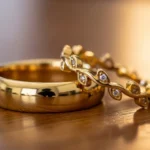
The beauty of gold lies in its warmth. When comparing 10k vs 14k gold side-by-side, the difference in color is subtle but noticeable to the trained eye. 14k gold possesses a rich, saturated yellow glow that people associate with luxury. Because 10k gold has less pure gold, its color is slightly paler and can sometimes have a very faint reddish or grayish tint depending on the specific alloy mix used.
At Wilton Jewelers, we often suggest 14k gold for pieces where the metal’s color is a primary feature, such as plain wedding bands or minimalist necklaces.
Purity and Hallmark Reference Table
For our international clients, understanding regional hallmarks is essential to avoid counterfeit goods.
| Karat | Purity Percentage | US/Canada Hallmark | UK/Australia Hallmark |
| 24K | 99.9% | 24K | 999 |
| 18K | 75.0% | 18K | 750 |
| 14K | 58.3% | 14K | 585 |
| 10K | 41.7% | 10K | 417 |
Market Value and Investment Potential
In the long term, 14k gold holds more intrinsic value simply because it contains more gold. If you are looking at your jewelry purchase as a portable asset, 14k is the superior choice. The 14k gold price fluctuates with the global market, but it consistently commands a higher resale value at refineries and pawnshops than 10k gold.
However, Wilton Jewelers recommends 10k gold for those who want the prestige of gold without the high entry price. It allows for larger, more intricate designs at a fraction of the cost.
Skin Sensitivity and Allergy Concerns
An often-overlooked factor in the 10k vs 14k gold debate is dermatological safety. 10k gold has a higher concentration of base metals, including nickel. For individuals with sensitive skin, this can lead to contact dermatitis or “jewelry rash.” 14k gold, having a higher gold-to-alloy ratio, is generally more hypoallergenic and safer for long-term wear against the skin.
The Diamond Connection: Security and Clarity
When setting a high-value diamond, the choice of metal is paramount. A diamond’s brilliance is defined by its clarity and the precision of its setting.
While 10k gold is harder, it is also more “brittle,” making it slightly more difficult for bench jewelers to perform intricate repairs or resizing. 14k gold provides the ideal balance of malleability and strength to hold a diamond securely while allowing for fine craftsmanship.
International Sizing: Ensuring the Perfect Fit
At Wilton Jewelers, we ship globally. Whether you are buying 10k or 14k, ensure you use the correct regional sizing chart:
| US / Canada Size | UK / Australia Size | Inside Diameter (mm) |
| 6 | L 1/2 | 16.5 mm |
| 7 | N 1/2 | 17.3 mm |
| 8 | P 1/2 | 18.1 mm |
Jack Reacher’s Professional Recommendation
Choosing between 10k vs 14k gold comes down to your personal priorities:
- Choose 10k Gold if you need maximum durability for a low price and do not have sensitive skin. It is the “worker’s gold.”
- Choose 14k Gold if you want a beautiful heirloom piece with a rich color, better resale value, and a more hypoallergenic composition.
For further reading on the legal standards of precious metals, I recommend visiting the World Gold Council for updated market reports and purity regulations.
Conclusion: Trusting the Wilton Jewelers Standard
Regardless of the karat you choose, the quality of the craftsmanship at Wilton Jewelers remains constant. We pride ourselves on providing the highest quality alloys that meet and exceed international hallmarking standards. Your jewelry is an extension of yourself—make sure it’s made of the right stuff.