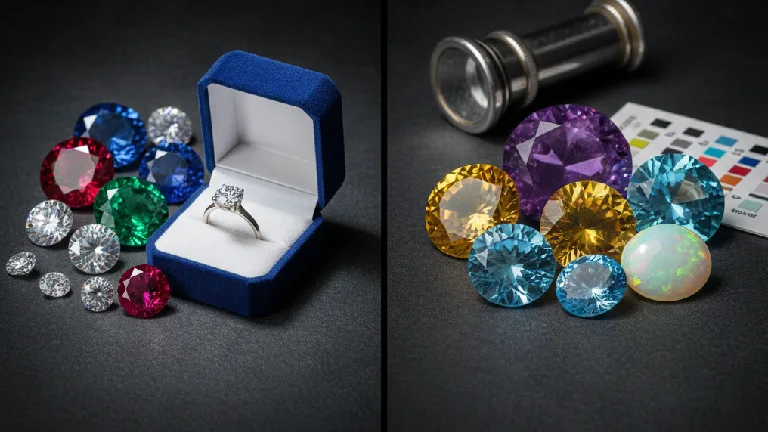
In the glittering world of fine jewelry, terminology often dictates price. However, one of the most misunderstood classifications in the industry is the distinction between precious vs semi precious stones. At Wilton Jewelers, I often encounter clients who believe that a “precious” stone is inherently superior to a “semi-precious” one. This is a misconception born out of 19th-century marketing rather than modern gemological science.
The Historical “Big Four”: Defining Precious Stones
Traditionally, only four gemstones have held the title of “Precious.” These were chosen based on their historical rarity, extreme hardness, and their association with royalty across Europe and Asia:
- Diamond: The hardest natural substance, symbolized by eternal strength.
- Ruby: The “King of Gems,” prized for its vibrant red hue.
- Sapphire: Known for its deep blues, though it exists in every color except red.
- Emerald: The most famous green stone, often plagued by inclusions but unrivaled in color depth.
When we discuss precious vs semi precious stones, these four usually command the highest price per carat. At Wilton Jewelers, we treat these as the “blue-chip” assets of the jewelry world.
The Rise of the Semi-Precious: Rarity Redefined
The term “semi-precious” covers every other gemstone in existence—from Amethyst and Topaz to the incredibly rare Tanzanite and Alexandrite. This is where the label becomes misleading. For example, a high-quality Paraiba Tourmaline (semi-precious) can cost significantly more than a low-grade Diamond (precious).
The modern collector at Wilton Jewelers is less concerned with the label and more concerned with the three pillars of value: Rarity, Beauty, and Durability.
Step 1: The Mohs Scale – A Guide to Longevity
The most practical difference in the precious vs semi precious stones debate is how long the stone will last. At Wilton Jewelers, we use the Mohs Scale of Hardness to determine if a stone is suitable for a ring or should be reserved for a pendant.
| Gemstone | Classification | Mohs Hardness | Suitability for Daily Wear |
| Diamond | Precious | 10 | Highest |
| Sapphire/Ruby | Precious | 9 | High |
| Topaz | Semi-Precious | 8 | Good |
| Emerald | Precious | 7.5 – 8 | Moderate (Fragile) |
| Amethyst | Semi-Precious | 7 | Fair |
| Opal | Semi-Precious | 5.5 – 6.5 | Low (Delicate) |
The Role of the Setting: Protecting Your Investment
Regardless of whether you choose a precious or semi-precious stone, the metal housing it is your first line of defense. At Wilton Jewelers, we emphasize that a delicate stone like an Opal or Emerald should never be set in a thin, low-karat band if you intend to wear it daily.
We find that 14k gold (585 hallmark) is the ideal partner for most gemstones. It provides the structural rigidity needed to keep prongs tight without the excessive softness of 24k or the potential brittleness of some 10k alloys.
Investment Potential: Resale Value and Rarity
In the context of precious vs semi precious stones, the “Big Four” have a more established global resale market. If you buy a high-quality Ruby, you can walk into a jewelry house in London, New York, or Hong Kong, and its value will be recognized instantly.
Semi-precious stones are more subject to fashion trends. While stones like Aquamarine or Morganite are currently trending in the US and Canada, their long-term resale value is less predictable than that of a Diamond or Sapphire. However, at Wilton Jewelers, we advise that if you are buying for joy and personal expression, semi-precious stones offer a color palette that precious stones simply cannot match.
Step 2: Clarity, Color, and Cut
The value of any stone, regardless of its “precious” status, is determined by its clarity.
A “Semi-Precious” stone with “Flawless” clarity will often be more valuable than a “Precious” Emerald that is heavily “Included” (filled with internal fractures). My advice at Wilton Jewelers is always to prioritize the “Face-up” beauty of the stone over the technical category it falls into.
Birthstones: The Personalization Trend of 2026
In Tier-1 markets, birthstones remain the leading driver for gemstone sales. This is where the precious vs semi precious stones categories blur most often.
| Month | Birthstone | Category | Meaning |
| January | Garnet | Semi-Precious | Protection |
| April | Diamond | Precious | Invincibility |
| July | Ruby | Precious | Passion |
| September | Sapphire | Precious | Wisdom |
| December | Tanzanite | Semi-Precious | Transformation |
International Sizing for Gemstone Rings
Gemstone rings are often harder to resize than plain bands because heat can damage the stone. When ordering from Wilton Jewelers, precision is key.
| US / Canada | UK / Australia | Inside Circumference |
| 6 | L 1/2 | 51.9 mm |
| 7 | N 1/2 | 54.4 mm |
| 8 | P 1/2 | 57.0 mm |
External Authority: Seeking Certification
Because the lines between precious vs semi precious stones are so thin, I always insist that my clients at Wilton Jewelers look for third-party certification. The GIA (Gemological Institute of America) or the AGS (American Gem Society) are the only authorities I trust to accurately grade a stone’s origin and treatment.
Jack Reacher’s Final Recommendation
If you are building an investment portfolio, stick to the “Big Four” precious stones. They are the currency of the jewelry world. However, if you are looking for a piece that speaks to your personality, explore the world of semi-precious stones. A rare Tsavorite or a deep-blue Spinel can be just as “precious” as any diamond when crafted with care at Wilton Jewelers.